

International University Network in Technical Communication
Organised by the tekom Europe Advisory Board for Professional Development and Training
Your participation in the International University Network inTechnical Communication is free of charge.
To join the IUNTC mailing list, contact Dr. Daniela Straub (d.straub@
Dr. Yvonne Cleary (yvonne.cleary@
Current events
Dear IUNTC members,
we are very pleased to announce that the next meeting of the International University Network in Technical Communication will take place on
Thursday, September 17, 2026, 4 PM CEST
Understanding the Economics of AI: A Perspective for Technical Communicators Artificial Intelligence (AI) represents a large and unwieldy topic that is positioned to effect the modern economy in many ways. The better technical communicators understand economic trends related to AI, the better they can prepare for them in to maintain future job security. This talk would provide an overview of AI in terms of economic – primarily business – practices. The speaker will also explain how technical communicators can use their understanding of these economic trends to position themselves for future career success. Included in this presentation would be a discussion of AI-related economic/business trends for technical communicators to follow and strategies for how technical communicators can address these trends effectively. The objective of the talk is to provide attendees with a foundation for understanding and addressing AI at an economic level within professional practices and educational contexts. |
About the speaker
Kirk St.Amant is a Professor and the Eunice C. Williamson Chair in Technical Communication at Louisiana Tech University where he serves as the Director of Louisiana Tech’s Center for Health and Medical Communication (CHMC) and oversees the Center's Health Experience Design Usability Lab. He is also an Adjunct Professor of Health and Medical Communication with the University of Limerick in Ireland and a Research Fellow in User Experience Design with the University of Strasbourg in France. His research focuses on usability in international health and medical contexts, global health literacy, and developing health and medical products patients in different cultures can use easily and effectively.
Participation is free.
To participate, please contact Yvonne Cleary: Yvonne.Cleary(at)ul.ie
We hope you can participate!
The online meetings lasts one hour.
They will be held on zoom - click here to join.
Code: tekom110
The IUNTC Program 2026
We are very pleased to announce that there are several meetings of the International University Network in Technical Communication will take place.
For 2026, the IUNTC is once again offering an interesting and varied program on different topics and in different formats, from lectures to presentations of research projects and results, discussion panels with input speeches and much more on methods, research and teaching in technical communication and related fields.
What? Title | Who? Speaker | When? Date | |
How to use Use-Lab in assessments You can assess your information products in a myriad of ways, depending on what you want to know – regulatory compliance, aesthetics, understandability? In this meeting we’ll deep-dive a few methods that Use-Lab often uses in assessments to better understand how to get the most out of an evaluation. We look forward to an interactive session in which participants vote for the methods they are most interested, or perhaps the aspects of the information products they most want to evaluate, and then look at those methods. Stephanie will bring examples to the session, but participants are welcome to come with examples of their own as well. | As a project manager at Use-Lab GmbH, Stephanie Schwenke designs studies to help manufacturers learn how well "real people" can work with their products and what they can do to make those products better. A strong love of the written word has a led to a special focus on technical documentation and in particular instructructions for use; a background in psychology (B.Sc., Universität Freiburg) and cognitive science (M.Sc., Universität Freiburg) proves useful in developing methods for testing documents in a way that keeps participants engaged and provides useful information for the authors. | Wednesday, February 18, 2026, 4 PM CET | |
Introducing a Cooperative Study Program in Technical Communication | Leading the user documentation team at Siemens Healthineers AG’s Advanced Therapy business area, Kathrin Reinhard has a background in languages, roots in software documentation, and is responsible for the user documentation of imaging and therapy systems in the clinical areas angiography, interventional radiology, and surgery developed and manufactured internationally and sold worldwide | Thursday, Apri 23, 2026, 4 PM CEST | |
Navigating the documentation requirements of the EU AI Act: How ISO/IEC 42001 can assist moving towards compliance The EU AI Act promotes the uptake of trustworthy artificial intelligence (AI), which, among other things, requires the sharing of comprehensible information along the AI value chain on how AI technologies have been developed and how they perform, for demonstrating compliance with this regulation. All AI documentation, including instructions for use, needs to contain meaningful, comprehensive, correct and clear information, that is relevant, accessible and comprehensible to each category of stakeholders. While these information attributes can be mapped to the information quality characteristics of the international standards on information for use, IEC/IEEE 82079-1 and ISO/IEEE 26514, respectively, the AI management system (AIMS) standard, ISO/IEC 42001, represents a structured framework that defines and documents an organization’s overall processes, procedures, and controls for ensuring trustworthy and responsible AI. In this talk, we will unpack the documentation requirements of the EU AI Act, review some of the documentation best practices for AI, such as model cards and data sheets, and take a deep dive into ISO/IEC 42001 as a management framework to help facilitate compliance with the regulation. Within this framework, we will explore the role of technical communicators as AI change agents in helping an organization handling the AI documentation requirements towards meeting regulatory requirements as well as stakeholder expectations. | Dr. Thomas Zschocke currently serves as a research associate of the Center for International Forestry Research and World Agroforestry (CIFOR-ICRAF), with headquarters in Indonesia and Kenya, respectively. He has nearly 25 years of experience in knowledge management, technical communication, research data management, and capacity development working for the United Nations and other international organizations in Africa, Asia and Latin America. He earned his doctoral degree in education from the University of Massachusetts Amherst, USA, and received a master's degree in oriental studies from the University of Cologne, Germany. | Thursday, May 7, 2026, 4 PM CEST | |
Metadata and linear algebra Data about data objects is omnipresent and makes a significant contribution to finding and understanding information. Smartly selected metadata guides creators and users of information in a targeted and efficient manner. The basic concepts of linear algebra - space, basis, vector and orthogonality - provide an intuitive approach to metadata, because they allow a surprising bridge from our everyday experience - the space we move in - to the more abstract considerations of metadata in a database for content management or content delivery. With the short (and not at all mathematical) detour via linear algebra and the intuitive understanding of vectors, orthogonality and uniqueness developed in the process, it is possible to navigate the metadata space just as safely and collision-free as your own living room. | About Fritz Adrian Lülf
| Thursday, May 21, 2026, 4 PM CEST | |
Where are we with AI in technical communication? A practitioner's perspective and ideas for an AI framework for technical writers "AI in technical communication is still an object of investigation. Trends and practices in the field are emerging, but most technical writers still seem to be uncertain about what direction to take. This presentation will try to summarise the current conversation about the topic and suggest a theoretical AI framework that can drive both research and best practices. | Gianni Angelini is an Italian technical writer with 15 years of expertise across diverse industries, including machinery, software, fire systems, fintech, and medical devices. He currently works as a Senior Labeling Specialist at Boston Scientific. Gianni lives in Ireland, where he earned a Master’s degree in Technical Communication from the University of Limerick. He is a member of tekom Ireland, where he actively collaborates to organise events for technical writers. He has published a beginner’s guide on the knowledge and skills required for modern technical writing, specifically aimed at an Italian audience. Gianni is now working on his second book on technical communication, intended for an international audience. | Friday, June 12, 3 PM CEST | |
Understanding the Economics of AI: A Perspective for Technical Communicators Artificial Intelligence (AI) represents a large and unwieldy topic that is positioned to effect the modern economy in many ways. The better technical communicators understand economic trends related to AI, the better they can prepare for them in to maintain future job security. This talk would provide an overview of AI in terms of economic – primarily business – practices. The speaker will also explain how technical communicators can use their understanding of these economic trends to position themselves for future career success. Included in this presentation would be a discussion of AI-related economic/business trends for technical communicators to follow and strategies for how technical communicators can address these trends effectively. The objective of the talk is to provide attendees with a foundation for understanding and addressing AI at an economic level within professional practices and educational contexts. | Kirk St.Amant is a Professor and the Eunice C. Williamson Chair in Technical Communication at Louisiana Tech University where he serves as the Director of Louisiana Tech’s Center for Health and Medical Communication (CHMC) and oversees the Center's Health Experience Design Usability Lab. He is also an Adjunct Professor of Health and Medical Communication with the University of Limerick in Ireland and a Research Fellow in User Experience Design with the University of Strasbourg in France. His research focuses on usability in international health and medical contexts, global health literacy, and developing health and medical products patients in different cultures can use easily and effectively. | Thursday, September 17, 2026, 4 PM CEST |
The online meetings lasts one hour.
They will be held on zoom - click here to join.
Meeting-ID 534 482 5910
Code 04711
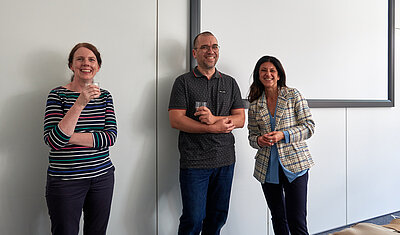
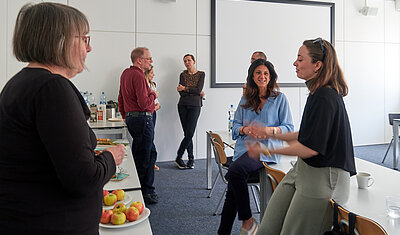
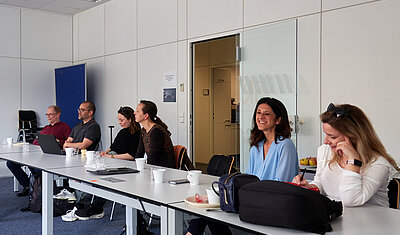
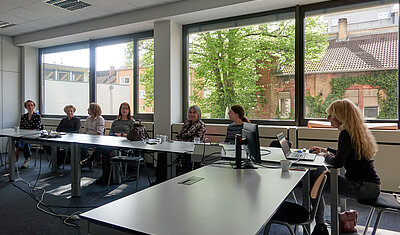
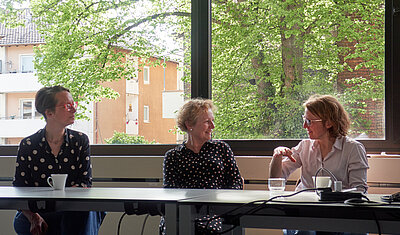
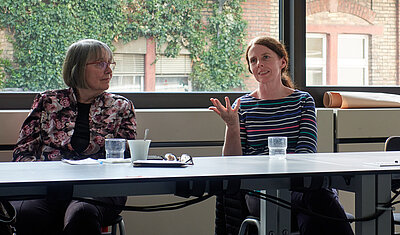
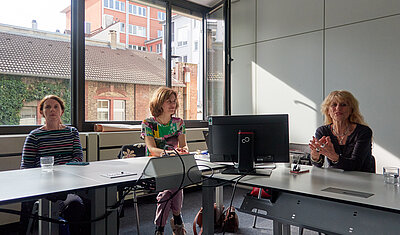
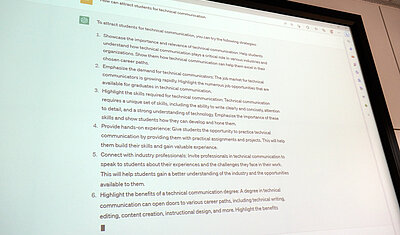
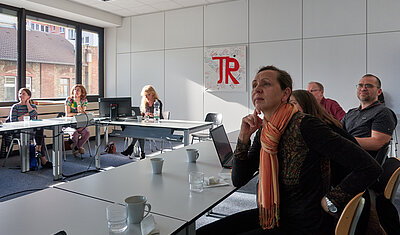
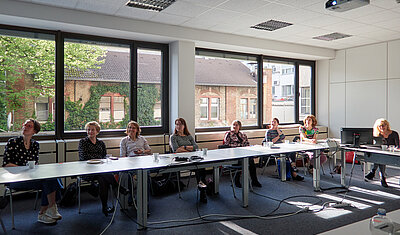
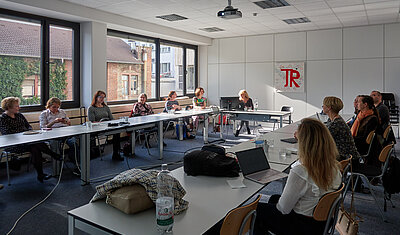
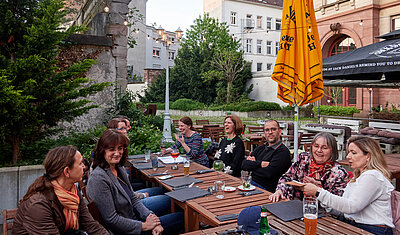
That was the first IUNTC in person meeting


Why taking part in the International University Network in Technical Communication

Would you like to join?
Your participation in the International University Network in Technical Communication is free of charge.
Information about Data Privacy and the Conditions of participation

An agenda for your benefit
The purpose of this International University Network in Technical Communication is to support university teachers and staff who already run, or are interested in developing programmes or modules in technical communication: through this network they will be able to exchange experience and ideas for launching or strengthening their programmes, or for research projects.
The network will facilitate online meetings, mentoring partnerships, and research projects and dissemination of university teachers and staff throughout Europe.
We meet regularly, about every 6 to 8 weeks in one-hour online meetings. Anyone who wants to can contribute a topic. We work in different formats: presentations, presentation of research projects and results, discussion rounds with input presentations, exchange of potential project partners, clarification of questions and concerns and much more.
Whoever wants to can actively contribute here or just take part.
The network is also relevant for teachers and staff in related disciplines, such as engineering, language studies, computer science, marketing, and communication studies.
A working group of the tekom Europe Advisory Board for Professional Development and Training is responsible for running the network and organizing meetings or events. The network was first established as an Advisory Board project in March 2020.
So far, the working group includes universities from more than 30 countries, from Europe and worldwide, including China, Austria, Belgium, China, Czechia, Danmark, Finland, France, Great Britain, Germany, Hungary, Ireland, Italy, Portugal, Romania, the US and other countries.
You are welcome to join any network meetings that interest you.
Our next network meeting will take place online. If your are interested to join, get in touch with us: d.straub@tekom.de

Why is the network necessary?
Throughout the world, millions of people work in technical communication roles, but the profession is still not very well known.
Technical communication education is at different stages of development in each European country.
In many European countries, no academic programmes are offered in technical communication.
The TecCOMFrame project identified ways to increase the number of programmes offered, and developed resources for people who are interested in designing modules or full programmes. This network follows on from that project.

Benefits for all
Benefits for universities:
Universities involved in this network will be able to create opportunities for students and will attract more visibility and higher participation in technical communication modules and programmes.
Benefits for students:
This network will help universities to develop and offer modules and programmes in technical communication. This is a growing field, with work opportunities for students with interdisciplinary skills, especially skills in languages, media, communication, and technology.
Benefits for industry:
This network will help to meet the recruitment needs of companies operating in the field of technical communication, by training graduates to meet the labour market shortage, and by helping young people seeking job opportunities in technological and innovative contexts.
What is technical communication?
According to the tekom Europe definition, “technical communication is the process of defining, creating and delivering information products for the safe, efficient and effective use of products (technical systems, software, services).”
This video shows a typical working day in the life of a technical writer at a large software company.